|
 |
 |
 |
| This is the
galaxy M31, the Andromeda Galaxy. It is one of our
closest neighboring galaxies, and fairly similar to ours.
In the sky, it's about 8x the width of the full moon, but
dim enough you need binoculars to see it. This image was
taken on 9/20/05 with a 135mm SLR camera lens piggybacked
on my ETX-105 for guidance. It's a stack of about 20, 30
second images. |
Andromeda
Galaxy again, 20, 30 second images, darker skies on 9/27/05.
Note the smaller satellite galaxy, M110, to the lower
left. |
This is the
North American Nebula, taken through my 135mm lens on 11/2/05,
90 second exposures. I'll get Canada later... |
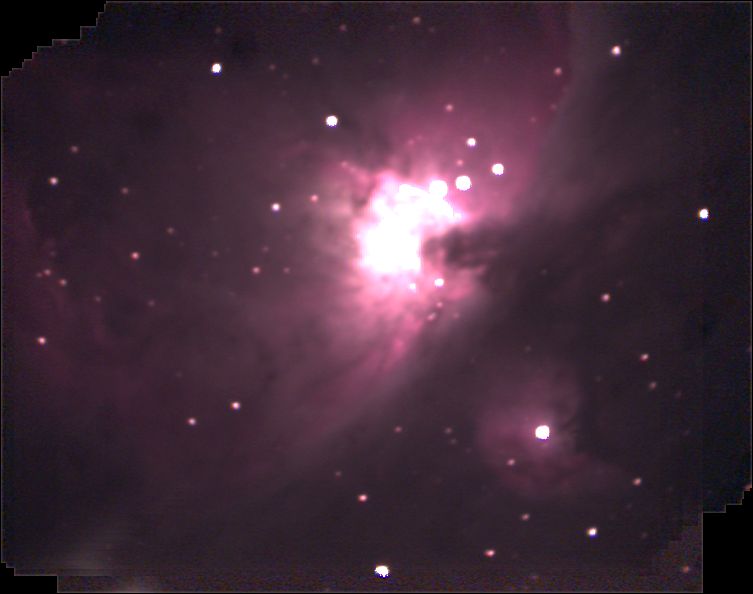
This is Orion's
sword - visible to the naked eye as 3 relatively dim,
fuzzy stars, but actually containing many stars and
nebulae. The bright nebula in the middle is the Great
Orion Nebula, M42. 60 seocond exposures taken on 11/2/05.
|
 |
 |
 |
 |
| This is The
Great Orion Nebula, M42, taken through my ETX-105. It's
an enormous, backlit cloud of hydrogen gas and dust. The
4 stars in the center (bleeding together here) appear as
a single, fuzzy star in the middle of Orion's sword to
the naked eye. This is a stack of 5 second exposures,
taken 1/1/05. |
Orion Nebula
again, taken 2/19/05. Stack of 5 second exposures. |
30 second
exposures from 2/19/05. I'll need to build a mosaic to
get the whole thing, visible at lower magnification in
the image of Orion's sword above. |
Same sequence
as previous images, expanded and processed differently.
Processing of this is tough, trying to bring out faint
details without washing-out the center. |
 |
 |
 |
 |
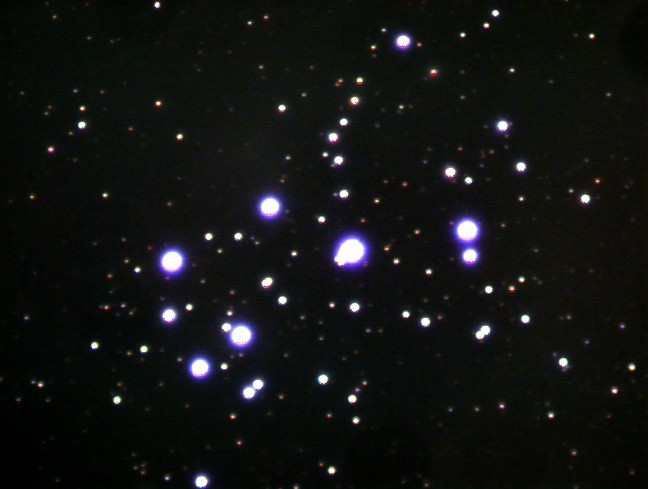
| The Pleiades,
M45, taken through my piggybacked SLR lens on 9/20/05 -
15 second exposures. There is nebulosity there, but it
isn't visible in this image. |
M34, an open
cluster, taken through the SLR lens on 9/20/05. 10 second
exposures. |
M34, with 30
second exposures from 9/20/05. The cluster is against the
backdrop of the Milky Way, so with longer exposures you
get a lot more stars. |
The globular
cluster (almost a mini-galaxy) in the constellation
Hercules: M13. Photo taken through the SLR lens on 9/19/05,
10 second exposures. See higher magnification version
below. |
 |
 |
 |
|
| M13 through
the telescope on 2/19/05, 10 second exposures. |
M13 on 4/13/05,
30 second exposures. |
Open cluster
M39, taken on 9/19/05, 10 second exposures. Not much
there, so I'm not sure I had the cluster centered. |
|
 |
 |
|
|
| Globular
cluster M92, 15 second exposures, taken on 2/19/05. |
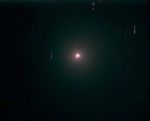
Comet Macholz,
taken on 1/1/05. Unfortunatly, there was very little
outgassing, so there was no tail. What is interesting is
that the comet moves so fast that the stars in the
background show trails after only about 5 minutes. |
|
|